Originally published by Huffington Post here.

With greenhouse gas emissions hitting record levels and passing climate scientist’s worst predictions, a new group of Chinese activists, traditionally silenced by an authoritarian government, is making its voice heard at the United Nations climate talks, the COP17, which began this week in Durban, South Africa.

China is the largest emitter of greenhouse gases in the world. With this unflattering superlative comes significant political pressure — from both the international community and China’s own population.

The delegation of independent Chinese non-governmental organizations (NGOs) believes that civil society must play a bigger role in the global climate crisis. According to one organizer, Dr. Yang Fuqiang from the Natural Resources Defense Council, “The world is paying attention to China, so the Chinese NGOs need to take action.”

C Plus is the name given to the initiative launched by 42 Chinese NGOs (full disclosure: my NGO, the Innovation Center for Energy and Transportation is a leading member) calling for domestic and global action to fight climate change. The NGOs who have lent themselves to this cause claim that the only way to create a fair, ambitious and legally-binding deal in Durban is to mobilize NGOs to put pressure on their governments to take action, another organizer, Jiliang Chen told me. “The best way of demanding governments’ action is to take actions by ourselves,” he said. The message is clear: climate action is too important and too urgent. It can’t wait. The top-down process of negotiations that we are seeing at the UN is too slow.

Xueyu Li

Li Xueyu from the Innovation Center for Energy and Transportation discusses carbon management at a recent conference in Beijing.

C Plus has three components, which together explain its name. C Plus stands for: Beyond Commitment. This means that NGOs must put pressure on their governments to achieve targets that are beyond those that have been officially stated. Second is Beyond China — in other words, NGOs outside and inside of China together must strive to influence their respective governments to take action. Finally, Beyond Climate. The initiative targets not just carbon reduction but other environmental measures as well such as clean water and air, public education, water conservation and preservation of forests.

The initiative was born out of the disappointment of the COP15 — the UN climate talks of 2009 in Copenhagen which bogged down over the degree of responsibility between developed and developing nations. The Chinese delegation largely held the view that, as a developing nation, it should be exempt from legally-binding international agreements constructed by the UN parties because it is more important that it grow its economy and lift people out of poverty than reduce greenhouse gas emissions. That task, they argued, should be left to the rich countries who, they claimed, created the problem in the first place.

However, the failure in Copenhagen galvanized NGOs to take actions with a new level of urgency. With headlines like “Climate change leads to extreme weather events: report” and “Scarcity of land, water pose severe challenge to mankind” and “Climate change threatens drop in grain harvest,” the case for immediate action is building in China. (This, even while the climate-denier position is gaining traction in especially the Republican quarters of American politics.)

With similar fault lines set to plague the talks in Durban, it will be interesting to see what role NGOs can play. In the last few years, NGOs have enjoyed increasing influence and visibility, especially after Chinese Climate Czar, Xie Zhenhua, praised NGOs last year for playing a “constructive role” in China’s climate policy.

And NGOs can claim some notable successes. As Chen reminded me, NGOs were responsible for the regulation which imposes the 26 degree Celsius cap on air conditioning units. They were instrumental in challenging the damming of the Nu River. A group of Chinese citizens organized together and stopped the construction of a dangerous paraxylene chemical plant in Xiamen.

“Sustainable development requires a paradigm shift of the society,” said Chen. “NGOs are such a small group, if they cannot work collectively, it is very unlikely that they could make the shift as they wish to see.” In Durban, Chinese NGOs have arrived as a team and are prepared to assert their demands.

Follow Lucia Green-Weiskel on Twitter: www.twitter.com/LuciaGGW

I recently read a brilliant article by China correspondent Evan Osnos in the New Yorker about his experience joining a Chinese tour group on a trip to Europe [The Grand Tour, April 18th 2011]. He describes a trip at blazing speed through five countries in ten days in which tourists were told to be vigilant about thieves and unnecessary engagement with strangers was not advised. “We were as mobile and self-contained as a cruise ship,” he writes. What struck me most was that his descriptions of the Chinese tourists reminded me a lot of us.

The Chinese tourists saw Europeans as slow and inefficient. Osnos recalls:

“We have to get used to the fact that Europeans sometimes move slowly,” [the tour guide] said. When shopping in China, he went on, “we’re accustomed to three of us putting our items on the counter at the same time, and then the old lady gives change to three people without making a mistake. Europeans don’t do that.”

And later:

Li made a great show of acting out a Mediterranean life style: “Wake up slowly, brush teeth, make a cup of espresso, take in the aroma.” The crowd laughed. “With a pace like that, how can their economies keep growing? It’s impossible.” He added, “In this world, only when you have diligent, hardworking people will the nation’s economy grow.”

And by comparison, the Chinese tourists view their own culture as efficient and nimble, allowing them to emerge as a richer and faster-growing economy:


Our guide had mocked Europe’s stately pace, but Zheng said her countrymen have come to believe that “if you don’t elbow your way on to everything you’ll be last.” A car paused for us at a crosswalk, and Zheng drew a contrast: Drivers at home think, “I can’t pause. Otherwise, I’ll never get anywhere,” she said.

And later, one tourist admits she is not impressed:

Midway through the trip, the daughter was politely unmoved. “Other than different buildings, the Seine didn’t look all that different from the Huangpu,” she said. “Subway? We have a subway. You name it, we’ve got it.” She laughed.

There is a sense throughout (and I have noticed this too in my own experiences in China) that Chinese people, generally, see themselves as more practical [read: better] than their European counterparts. They view their culture as more efficient, wasting less time in “high culture” like fine art, slow dining and savoring the aroma of a cup of coffee.

Americans, I would argue, are actually a lot like these Chinese tourists. For example, I was struck by how much Osnos’s reading of the Chinese in Europe is similar to Alexis De Tocqueville’s reading of Americans in his famous 19th Century book “Democracy in America.” Tocqueville sees Americans as pragmatic people (think of the proverbs in Ben Franklin’s Poor Richard’s Almanac) who seek virtue and honor through hard work and good character. Believing that every man could “pull himself up by the bootstraps,” Americans rejected European aristocracies – in which one could inherit virtue and nobility in only one way: by blood. In the aristocratic social structure, with their inheritance (whether it be substantial or not) secured from the moment they are born, Europeans didn’t have to be so pragmatic and hardworking. Instead they had abundant leisure time in which they could pursue philosophy and fine art. For Tocqueville, the American emphasis on work made them “seekers of the middle” — a society based on utilitarianism, efficiency and conformity. Americans, observed by Tocqueville, chauvinistically pledged themselves to the American dream. With work as the central value in society, Americans had no taste for fine things and instead sought comfort rather than high beauty. Osnos’s descriptions of Chinese tourists in Europe frowning on the slow pace of European life strikes uncanny cords of similarity with Tocqueville’s description of early Americans.

Chinese tourism under Mao Zedong was deemed anti-patriotic and illegal until 1978.  And it wasn’t until 1997 that Chinese people could travel beyond certain countries in Southeast Asia. As a result Chinese people haven’t learned to be tourists in the way that Europeans, Canadians or Australians have. Likewise, Americans are known for their infrequent overseas travel (many Americans don’t even have passports). I am reminded of the old joke: What do you call a person who speaks two languages? Answer: Bilingual. What do you call some who speaks three? Answer: Trilingual. What do you call someone who speaks one language? Answer: American.

And why is that? Perhaps it is because, we like China, have a deep rooted feeling that we are the best nation in the world. “China” in Chinese is Zhongguo, literally, “middle country,”  as in the middle of the earth (that is how we get “middle kingdom”. Like the “unmoved” daughter Osnos writes about, Americans believe that America has everything and is indeed a “chosen” nation to put it in religious terms. If you are already among the chosen, why travel?

To the Europeans, Americans in the 19th Century were the pragmatic, utilitarian engineers with all the related connotations. Now, from an American point of view, China is taking that role.

May 9, 2011

I have to admit I don’t spend much time thinking about the tedious war on science known as “climate change denial.” I find this contrarian bunch to be small-minded and senseless and mostly just boring because without any scientific credentials they are trying to make a scientific argument (that climate change doesn’t exist or if it does, it is natural) with which 99.9% of trained scientists disagree. Personally, I’d rather get my science from scientists.

But there is a bigger reason not to waste my valuable cranial capacity coming up with responses and counter points to this giddy flock of charlatans: Even if they were right, it wouldn’t matter.

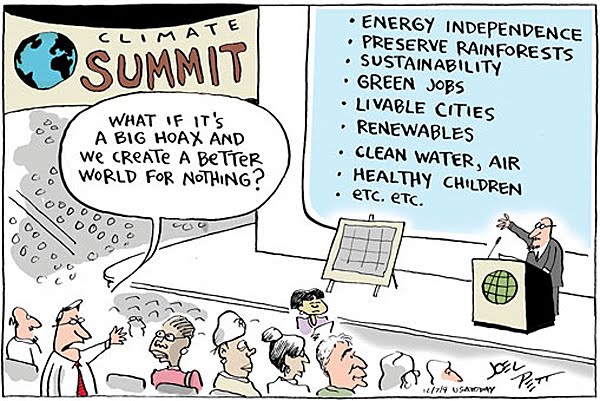
First of all, we know that Earth has serious environmental problems. Urban air pollution, trashed rivers and algae covered lakes are palpable evidence. We also know that we waste a lot of energy, through inefficient technologies or practices. Fossil fuels are expensive, pollution is ugly and fresh healthy food and environments are good. These are pretty basic assumptions that I think most people can agree with. Even if the human-generated greenhouse gases emitted into the earth’s atmosphere don’t cause sea levels to rise resulting in wide spread destruction of arable land, food shortages, environmental refuges and widespread disease, it is still a good idea to clean up our environment and use energy more efficiently. The cartoon below sums up the logic I am getting at:

The other reason why climate deniers are not interesting to me is that the energy policy of the largest emitting country in the world, China, is not driven by the science they aim to destroy. I was surprised to learn that many of the members on the climate change negotiation team in at the high-profile UN climate change conferences in Cancun and Copenhagen held personal beliefs that were aligned with climate deniers. Even one of my colleagues admitted to me a few months back that she “isn’t sure that climate change exists.” This is a woman I have been working with for five years on promoting climate change policy in China, so at first I was taken aback when I heard her confession. But then I learned that what I call “climate change policy” she thinks of as “sensible energy policy”. Same concept and purpose, different rationales and language. If you want a clean environment, healthy air and water and cheap and abundant renewable energy, it doesn’t matter if climate change exists or not. They are different means to the same end. And, regardless of the science, geopolitics dictates that China needs to have an energy policy that will promise inexpensive and abundant sources of energy in the coming decades.

In 1993, China became a net importer of oil. In 2009, China became a net importer of coal.  In 2010 China’s rapidly growing economy surged ahead to become the largest consumer of energy in the world. Today, coal, oil and natural gas fuel the Chinese economy. But those sources are becoming more expensive and available only in distant and (often war torn) parts of the world. If China is going to keep its economy growing at the current rate, it will need to expand its exploitation of new sources of energy, like hydro, solar, wind and nuclear.  As the second largest economy in the world, growing at an annual rate of 10%, China doesn’t have a choice of this or that type of energy. It must take whatever it can get.

Concern over climate change has brought new urgency to green technology and the renewable energy industry, transforming the market and breathing new life into solar and wind farms, electric vehicles and low-carbon appliances. While these products may help the world avoid climate disasters, from China’s point of view, they also help China continue its break-neck growth rate without becoming too dependent on imported fossil fuels. In short, the need to diversify energy sources is a far more important driver of China’s energy policy than climate change.

So we have an odd situation where a country run by lawyers (the US) is incubating climate deniers who have launched a war on science. And a country run by scientists (China) doesn’t really care about the science of climate change, but is enacting ambitious new climate-saving policies on the basis of geopolitics. Go figure.

But it is for that reason that I don’t spend much time concerned about the fact that many of China’s top climate policy makers are climate deniers (although I do worry about this fact, very much, in the US).

First published in The Nation here.

Lucia Green-Weiskel | April 21, 2011
In the wake of the partial meltdown of nuclear reactors at the Fukushima plant in Japan, China announced it would shelve plans for vast expansion of its nuclear power capacity, at least temporarily, until more stringent safety checks are performed. Construction will eventually resume, but with a potentially scaled-back role for nuclear power and with solar and wind energy picking up some of the slack. If nuclear remains a small fraction of China’s total energy mix (just 2 percent today, compared with America’s 20 percent), and Beijing looks to solar and wind for future energy growth in the era of climate change, the boost to those industries could make renewables cost-competitive with fossil fuels much earlier than previously projected.


The announcement marked a significant policy change. As recently as January, after reporting a breakthrough in nuclear fuel reprocessing technology, China reaffirmed its commitment to an expansion of its nuclear energy capacity that would be greater than that of all other countries combined. Construction began on twenty-seven reactors, adding to the existing thirteen. Another fifty-two were planned.

Just days after the earthquake and tsunami struck Japan, China passed into law its Twelfth Five Year Plan, which will serve as the country’s economic blueprint until 2015. The primary theme of the plan is sustainable development, with a high priority on securing nonfossil fuel energy sources. New policies include reducing carbon intensity by 17 percent by 2015. That means manufacturing entities would need to emit at least 17 percent less carbon in 2015 than they emitted in 2010 for the same amount of economic output. The plan also mandates ambitious energy-cutting targets, implementation of market mechanisms like cap and trade, and generation of 11.4 percent of total energy from nonfossil fuels by 2015, up from the current 8 percent. Pre-Fukushima, a sizable portion of that 11.4 percent was to come from nuclear sources. That target is being reconsidered.

The planners of the world’s second-largest economy are facing a labyrinth of competing constraints. China is the world’s largest user of energy, at a time of global shortages and high fossil fuel prices. The ruling party feels compelled to seek continued rapid economic growth in order to employ its people and maintain the image of a country steadily marching toward industrial modernization—lest the party lose its legitimacy and risk a Cairo-style uprising. So China must try to expand economic development, but not its greenhouse gas footprint. That’s like driving from New York to Boston and then figuring out how to use the same amount of gas to get from Boston to California. To achieve this, China will have to wring more energy from sources like wind and solar. And that is in fact the plan. The country’s National Energy Administration said in March that energy from solar sources may double over the next five years, from five to ten gigawatts.

Even if it doesn’t reduce the role of nuclear energy, China is emerging as a pacesetter in solar and wind technology. It currently produces half the world’s solar panels; in the city of Rizhao, population 3 million, 99 percent of homes have solar hot-water heaters. Last year China reportedly installed three times as much wind-power capacity as the United States, and the pace is expected to increase in the next decade. Even if China were to implement its most ambitious nuclear plan, total energy from that sector in 2020 would be about a third of projected wind output. Without nuclear expansion, wind and solar will need to make up the difference. Renewable energy authorities have indicated they are optimistic about their ability to meet expanded demand.

* * *

There are good reasons for China to shelve its nuclear industry for good even without the lesson of Fukushima. Although it is less earthquake prone than Japan, China is not immune to a temblor-triggered disaster. In May 2008 a massive quake, 7.9 on the Richter scale, hit Sichuan province, where many nuclear warheads as well as several reactors and two plutonium plants were located. No significant damage to the nuclear facilities was reported, but there is no guarantee the outcome will always be so fortuitous. After all, before Fukushima three of the largest nuclear accidents in history—Lucens in Switzerland in 1969, Three Mile Island in 1979 and Chernobyl in 1986—were not caused by seismic activity. Like all nuclear facilities, China’s plants are vulnerable to human and mechanical error as well as terrorist attack. And many of the newer plants are in densely populated areas, so fallout from a meltdown could cause massive suffering.

Another drawback of nuclear energy is the vast amount of water required to generate steam and to cool spent fuel rods. China’s energy sector, like that of many other countries, competes with agriculture for water, which is in scarce supply—the country has suffered major droughts in the past decade, with some rivers running dry. The problem became so serious that in 2002 Beijing launched the giant South-to-North Water Transfer Project, costing approximately $62 billion and displacing hundreds of thousands of people who lived along its routes. Worries about food security and grain prices have already led China to express concern about biofuels. Food shortages could result in vastly increased imports, which would drive up global prices. And, as with all other countries that rely on nuclear power, China hasn’t solved the problem of storing ever-growing quantities of nuclear waste.

There is no question that China will find it difficult to restrict nuclear energy. It is the type of project the government is best at: large-scale infrastructure requiring extensive government investment and oversight. On the surface, nuclear appears to be a quick fix to two of the most pressing problems facing Beijing: air pollution and the need to become less dependent on foreign energy sources. For this reason, most analysts say growth in nuclear power is inevitable.

The biggest obstacle to a nuclear-free China may be the industry itself. The country has a powerful nuclear interest group that is not likely to yield quietly to restrictions, and the intermingling of business interests and politics strengthens nuclear advocates in China and the United States. In January President Hu Jintao met with Barack Obama in Washington at a state summit, which generated $45 billion in business between the two countries, with many of the projects advancing nuclear and “clean coal” interests. China’s State Nuclear Power Technology Corporation (SNPTC) walked away with a $5.3 billion deal with US-based Westinghouse, which will provide development, service and maintenance on its AP1000 nuclear technology in Zhejiang and Shandong provinces.

With its pockets full of cash and the prospect of new deals to come, the nuclear lobby didn’t skip a beat in responding to Beijing’s post-Fukushima freeze. Representatives from the China National Nuclear Corporation issued a statement that its nuclear safety standards were higher than the world average.

The government is split on the issue. Xie Zhenhua, who led the Chinese negotiating team at the UN climate talks in Cancún last year and is vice chair of the National Development and Reform Commission, the country’s most powerful agency, denied there would be any slowdown in the expansion of nuclear power. But Premier Wen Jiabao said China’s long- and medium-term nuclear plans would be “adjusted and improved.” A month before the meltdowns in Fukushima, a top official from the Energy Research Institute of the NDRC said nuclear targets were too aggressive and could put too much pressure on the industry, resulting in compromised safety. But Tian Shujia, who works in nuclear safety at China’s Ministry of Environmental Protection, defended the industry. “The safety of China’s nuclear power facilities is guaranteed and China will not abandon its nuclear power plan for fear of slight risks,” he said.

Those who watch China closely know there are reasons to doubt the government’s commitment to public safety. The reflexive cover-up of the deaths of several workers at one of the Olympic sites in the lead-up to the 2008 Beijing Olympic Games came under international scrutiny. And concern for safety has not slowed China’s coal industry, which in 2004 accounted for over 35 percent of the world’s production and 80 percent of global coal-mining–related deaths. As of this writing, the government has no plans to implement new nuclear safety measures.

Even so, it is possible that one consequence of the horrific meltdown in Japan will be China’s accelerated development of clean and safe energy. With its huge economy, driven by central planning and aggressive government investment, China is the only country building a green-technology industry on a scale that could bring down global prices of solar panels and wind turbines, making them affordable in the developing world. This should be a key part of the global strategy to keep emissions under 350 parts per million, the maximum threshold recommended by climate scientists. For this to happen, solar and wind energy must become cost-competitive not only with nuclear but with fossil fuels. Given China’s size and unique role as world manufacturer and exporter, it is fair to say that it is the best hope for giving solar and wind energy that boost.

As China goes, so goes the rest of the world.


Losing Our Cool: Uncomfortable Truths About Our Air-Conditioned World (and Finding New Ways to Get Through the Summer)

By Stan Cox

New Press, 2010

272 pages, $24.95 (Hardcover)

Available on Amazon here and Google books here

Reviewed by Lucia Green-Weiskel

It’s not an obvious choice to read a book about air conditioning. Yet, without getting much attention, climate control is central to our life. Air conditioning influences economic development, community building, medicine, art, culture and even foreign policy. It has allowed people to populate—in increasingly greater numbers—the traditionally uninhabitable parts of the earth’s surface. And some say it will likewise allow us to live in a future where climate change has made even the habitable parts of Planet Earth unlivable.

Everyone is familiar with the climate controlled life. The experience of feeling the hot furnace air of the outdoors hit you in the face when you step out of a store in July. Or the feeling of typing with cold knuckles in a well air conditioned office when it is 98 degrees and muggy outside. What about the opposite experience? I recall tossing and turning all night during an air-conditioning-less summer in Hong Kong. Or the experience of sitting in traffic – windows down and no AC— sun beating down on the car roof as its inhabitants find their legs sticking to the seats. These images are likely familiar to most, but rarely do we take the time to think about the ways that air conditioning has changed our lives and shaped our culture.

As Losing Our Cool explores, air conditioning plays a key role in many of the trends that are central to the American way of life: From McMansions and the increasing size of the average home, ubiquitous central air, sprawling suburbs to a growing commuter culture and mega-malls (and an 87,000 square foot indoor, air-conditioned flea market in Florida). From the emergence of the year-round business dress code to southern migrations (both for people and industry) and even to wars in tropical countries. The thread linking these together is our ability to control indoor climates and the creeping progression of air conditioning from a luxury to a necessity. Indeed the American Way of Life – the DNA-level instinct of each American to build his or her own mini-palace over one’s life time leading to a perennial expansion – to put in the new pool, build the new deck or den or finally buy that second home – is all held ransom to the technology of air conditioning.

But these trends gave birth to other phenomena more worrisome. For example, the “heat island” effect – a condition when urban areas are hotter than surrounding rural areas causing more people to buy air conditioners. This leads to the “heat canyon” effect – when the hot air exhaust from the AC units get trapped in the heat-absorbing concrete of the narrow alley ways and streets of cities causing the already hotter area to become even more hot. Thus, AC is like an addiction – the more we use it, the more we need it.

Heavy reliance on air conditioning causes water shortages and electricity spikes. Most urban brownouts or blackouts happen during the month of August when AC units are operating at full blast. In an effort to use climate controlling technology more efficiently, home owners install extra insulation around doors and windows. While this saves energy, it also stops the natural circulation of fresh air through the building leading to toxic build ups of radon, carbon monoxide, mold and bacteria. Dangerous off-gassing from new shower curtains (have you ever smelled one right out of the packaging?) or household cleaning products like Windex that are demonstrably dangerous for human health, get trapped indoors without windows or cracks through which to escape.

But the focus of Cox’s book is just as much on the social and cultural effects than on health. Controlled climates have resulted in a decline in outdoor activity and community events both spontaneous and planned. Cox points out that home air conditioning reduces the chances that people will end up in a place where they are likely to encounter a neighbor or a stranger, thus eliminating many of the interactions that facilitate the development of community. Sterile, ghost like suburbs are annexing more and more wild land throughout the south. These are housing complexes that are full of people but devoid of community.

Air conditioning has allowed whole cities in the south to exist where otherwise they may have just been a small town. A growing number of children are raised in southern cities where it is too hot to play outdoors during the summer months. Instead they adapt to indoor activities — video games and TV. As a result, childhood and adult obesity are on the rise as people stay indoors huddled in front of their air conditioners while temperatures spike outside.

AC has even changed our foreign policy. It would have been much more difficult to persuade thousands of US soldiers to spend summer months in places like Iraq and Afghanistan – where temps soar to over 110 degrees—if they were not also promised an oasis of AC. Instead of the old fashioned open-air jeep, today’s soldiers drive through Iraqi towns in air conditioned Humvees with windows rolled up and tinted. Without being able to see each other’s faces, it is much harder for the soldiers to win the hearts and minds of the Iraqi people.

But Cox is not just a cultural Luddite finding new ways to problematize progress. The book cannot be summarized as a one-sided diatribe against the evils of air conditioning. Similar to other books like those that look at industrial history through the evolution of cement or public health through the history of sewers, Losing Our Cool has a genuine aim to teach us more about ourselves – our society and our culture – and is not just an angry rant designed to make the climatically comfortable feel guilty.

Cox writes with an ethos that to live well is best. The most succinct quote of the book – and the author’s proclaimed personal view – comes on page 109. To the question of whether to use AC, one anonymous apartment resident replied: “We don’t use the air conditioner because it makes it too hot outside.” Cox has a bias but he is not necessarily a poster child of moral rectitude: “Please don’t misread me,” he writes. “I am not an ascetic, a Stoic, a Luddite, a miser, an ‘econag’, or a person of unmeltable moral fiber. I’ve lived this way [without AC] because I prefer it.”

And indeed, we see in the book that climate control is responsible for many of the improvements in our lifestyles: the declines in diseases and infant mortality, the improvement of micro surgery and the production of certain drugs. Indeed, climate control has made much of the economic productivity in places like Phoenix, Houston, and Atlanta possible. “I wrote this book to reopen the debate over whether our indoor environments should be refrigerated,” the author claims in the book’s preface.

Regarding our energy consumption habits, air conditioning is a new angle on an old story: Americans consume more than our proportionate share of energy and it’s unsustainable. But what about developing countries—many of them with tropical climates? A clear flaw of the book is that it is US-centric. If the trends are unsustainable in our American society of over-consumption and extremes, what are the implications of the spread of AC in the developing world? We know that it is there and not here where population growth is exploding and a massive new middle class is emerging. Yet, although one chapter on India attempts to poke at this, we can only wonder what will happen when affluence and its associated demands spread in the rest of the developing world.

Cox does not solve this conundrum but he does articulate the problem well and then proceeds to drop it and all its heft into the reader’s lap. The final chapter offers some solutions for home owners and policy makers—both technology and non-technology-based, which provide some tangible suggestions about where we go from here (and how to find new ways to get through the summer, as the subtitle suggests).

The book succeeds at being informative but not intimidating, urgent without being alarmist, righteous but not obnoxious. We learn not only of the larger trends that illustrate how climate control has changed the arc of our existence but also arms us with possible solutions and new ways of thinking about an old problem. Losing Our Cool is a nerdy beach read, packed with facts, observations and quotes ready to be taken from the page to your next cocktail party. Cox is thorough and persistent. He does his homework so you don’t have to do yours.

More on Electric Vehicles
I was tempted this week to write about Ai Weiwei, the Chinese dissident artist who was detained while traveling to Hong Kong last week. Or Bob Dylan—who performed last week to a Beijing audience, the first notable Western musician to be given the stage in Beijing since Bjork angered authorities in Shanghai when she called for an independent Tibet at the end of a song, which resulted in  a nationwide shutdown of Youtube. Or perhaps former US Ambassador to China and Republican presidential hopeful Jon Huntsman’s recent harsh remarks about China’s human rights.

But instead I am going to write again about electric vehicles in China. This weekend I was a panelist at the China Energy and Environment Conference at the Kennedy School of Government at Harvard University. I presented on the panel called “The Future of Transportation” along with Dr. Pricilla Lu, Chairwoman of Zap electric vehicles and Dr. Hongyan He Oliver a former research fellow at the Kennedy school. Dr. Lu presented an overview of electric vehicles particularly subsidies, and government investment in R&D. One interesting point she made was about the different philosophy between the US and China on subsidizing industries. In China, Dr. Lu said, Chinese companies get reimbursement from the government after certain work is done if it reaches specific criteria. In the US the money is granted to an institution before the work is done. This, Dr. Lu, argues allows Chinese companies to compete more against each other resulting in a better quality product. In the US, states (and banks and companies) that are going bankrupt receive “bail outs.” In China, provinces and companies that are doing well get bonuses from the government. It is the opposite philosophy and from Dr. Lu’s point of view, demonstrates that capitalism works better in China than in the US.

I was in the unusual position of playing the negative card (not my usual role). After Dr. Lu’s talk, and Dr. Oliver’s overview about the rapidly growing growth of the transportation sector and the various demands on government planners and natural resource, I presented the findings from my recent report for the United Nations: electric vehicles aren’t necessarily better for the environment than traditional internal combustion engine vehicles. In fact, EVs are only as environmentally friendly as the electricity grid from which they pull their energy. In China, those grids aren’t very clean. With 80% of energy generated from coal, we found that in only two regions in China is it better for the environment to drive an EV than a traditional internal combustion engine. From a life-cycle GHG emission standpoint, electric vehicles generally have a larger carbon footprint than regular gas-driven cars with internal combustion engines.

We compared the all-electric Nissan Leaf with the Nissan Tiida – a car that is comparable in body and chassis and overall user experience. We found that GHG emission changes range from a 23% reduction to a 36% increase over the use of the Tiida. In the graph below the vertical axis is grams of carbon dioxide equivalent per kilometer driven. The horizontal axis shows the different electricity grids across China: North China Grid, North East Grid, Central China Grid, South China Grid, Hainan Power Grid and the average for the Nissan Leaf. The blue bars represent the GHG footprint of the gas-driven Nissan Tiida.

For electric car enthusiasts, this is not good news. More on the later….

I am currently working on an article about China’s plans to boost nuclear energy — a key factor in China’s effort to “green” its power grids — in the post-Fukushima world for The Nation which I will post in the next couple weeks.

I work for a Chinese NGO. But in that capacity I am frequently asked to contribute analysis and even news stories to US-based publications like The Nation, Huffington Post and Grist, for which I write regularly.

This means that every once in a while I suddenly have to take off my NGO advocacy hat and put on the guise of an investigative journalist.

In the past two years I have noticed some interesting phenomena as a foreigner working in China both as a journalist and an activist. Below are a few observations:

It is hard to find the truth. Many potential sources of information are afraid to talk or provide any insight or information outside of the official party line that is constantly pumped into the media or any other source of public information. Beijing is an efficient dictatorship that has two successful ways of keeping dissenters quiet. The first is though censorship and the second is through extra-legal punishment. While there are ways of getting around the web censors in China (using connection-slowing proxy servers that come with a high monthly fee) most people don’t have the time or perseverance to get beyond the great Chinese firewall. For those that do talk, bad things happen. When I was in China last, a reporter who wrote a story that was critical of the government had thugs break into his house and cut his fingers off the day the report was published. Last week, a blogger who had mentioned he was being followed disappeared and then reappeared later “recovering” in a hospital, although it was not clear from what. This happens so often that Chinese people have adopted a tongue-in-cheek slang word: to disappear is to be “harmonized.”

There is no truth. This is a brick wall that I have run into many times. Often as a journalist, but more critically as an activist. Basic information on simple policies is  just not available or, worse, contradicting. Beijing is a sprawling web of bureaucracies with long and complicated names. For example, when looking for the government body responsible for adopting international standards for measuring greenhouse gases, I was turned away at the Chinese Academy for Environmental Policy at the Center for Climate Policy at the Ministry of Environmental Protection and told that instead I should go to the China Standard Certification Center of the National Institute of Standardization under the Standardization Administration of China which is part of the General Administration of Quality Supervision, Inspection and Quarantine.  A knowledgeable colleague told me that actually I should go to the Department of Climate Change at the National Development and Reform Commission. And there is also the National Energy Saving Center, the Energy Research Institute and many others. Once, a red faced high level member of the EPA, over lunch in Beijing, told me he was so fed up with Chinese bureaucracy he felt like slamming his head against a wall.

US media misses all the good moments. Somehow the mainstream media misses all the good stories in China. For example a non-existent Cairo-inspired “protest” in February was attended almost entirely by foreign correspondents and police (but no protesters). One observer noted: “No one shouted slogans, no one held signs, it was just a group of people standing around photographing each other.” Yet, the place where civil society is stirring – in the environmental NGO community, there has been little coverage.

There are surprising moments of clarity. Once in a while, something happens which counters all of the above statements. For example, last week, I was trying to find information about whether water shortages would impose a barrier to large scale expansion of nuclear power capacity in China. None of my NGO contacts could answer the question. At the bottom of a Google rabbit hole I found some old pages of press releases issued by the Chinese Ministry of Water. They were translated into English and full of ridiculous typos but on each one there was a contact name and phone number for Minister of Water himself. I logged onto Skype and called the number. An eager and cheerful voice picked up after the first ring and answered every question I had quite satisfactorily.

No one seems to be able to predict China’s behavior. After the Soviets broke diplomatic ties with Beijing in 1956, many China experts predicted that Communist China would collapse, but they were wrong. Again, after the Tiananmen Square massacre in 1989, foreign observers predicted that China would break apart like the Soviet Union and that it couldn’t withstand the economic isolation that happened as a result of the Tiananmen incident. Again, this didn’t pan out. In the 90s when China first started hitting 10% annual growth rates, economists swore that it couldn’t last beyond a couple years. But they were wrong. Something propels China forward that no one seems to have put their finger on.

I will let you know if I find it.

Both the US and China have pledged to put 1 million electric vehicles on the road in the next decade (see here and here). But are electric vehicles really better for the environment?

There is a common misconception that electric vehicles are carbon-neutral and that their impact on the environment is as non-offensive as the quiet sound of their humming engines.

But electricity doesn’t come from nowhere. To have a live outlet, tons of dirty coal (or sometimes natural gas or uranium) must be consumed at a power plant, generating electricity which then must be stored and transported to a building or charging station. This process is in and of itself a carbon intensive one. In the United States and China, the vast majority of the nation’s electricity is generated by coal, which, according to the Intergovernmental Panel on Climate Change, has a much higher global warming potential than conventional vehicle fuels like diesel or gasoline.

So when we promote electric cars are we just shifting the emissions from the tail pipe to the power plant?

In the last three months, I have worked with my colleagues in China at the Innovation Center for Energy and Transportation on a report commissioned by the United Nations on the life-cycle carbon impact of electric vehicles.

What we found may surprise many.

We found that pure battery electric vehicles may not always improve environmental impact of transport as much as we would like to expect; in fact, in some regions, electric vehicles are not an environmentally friendlier technology, particularly in terms of GHG emissions, because of the source of electricity which powers them.

Except for one region in China, compared with conventional vehicles, electric vehicles do not significantly reduce emissions – from a lifecycle point of view. After all, electric vehicles are an energy conversion and not a clean energy technology.

In order to generate data that reflects the lifecycle GHG emissions we look at the environmental impacts of a sequence of events in the fuel or battery’s life. For electric vehicles, we look at the emissions associated with the entire life of the battery from the mining of raw materials such as lithium, to the transportation and storage of energy to the disposal of waste material associated with the battery pack. This is what we call “Mine-to-Pack” emissions. For a conventional vehicle, we measure the emissions generated during the fuel’s life cycle, from the oil well to the tank, or “Well-to-Tank” emissions.

This analysis points to a clear implication for policy: Electric grids must be made more efficient or be more reliant on renewable sources of energy such as wind and solar.  This means replacing coal plants with renewable energy on a large scale, producing what many call a “smart grid.” If renewables aren’t commercially viable, then we need to install new technology to burn coal more cleanly or capture the emissions that come from coal. In the US and China (the world’s biggest coal-consuming countries) these are existing areas for government-led research and development.  But there is still a long way to go before so-called clean coal or renewable energy can be economically feasible in order to remake the electricity grids in either country to something we can call “smart.” Our report for the UN adds evidence to an existing pile that electricity grid reform should be priorities for both Washington and Beijing.

Last week John McCain, in a joint appearance with Australian Prime Minister Julia Gillard, said that the US and Australia should work together to rein in China. “They have been acting very assertively in the region,” he said. “The fact is they are a rising power and they are a military power.”

“Now that doesn’t mean to me that there is going to be conflict,” he said, “ . . . but it does mean that Australia and the United States must ensure that basics like freedom of the seas are observed by the Chinese.”

McCain’s comments are eerily reminiscent of two bygone eras, in which there was talk of reining in China. The first is the era of post World War II anti-communism hysteria that mostly targeted the USSR ultimately culminating in the Cold War, but which was also pointed at China and lasted from the 1950s until the fall of the Soviet Union in 1989. The origins of the anti-China piece of this broad arc of history are laid out in mesmerizing detail in a chilling 1974 book written by an Australian Franz Schurmann called, “The Logic of World Power: An Inquiry into the Origins, Currents, and Contradictions of World Politics.” In it he traces the rise of the Taiwan Lobby – a  motley group of politicians, legislative aides, intelligence workers, academics and journalists, who cohere around a shared belief that China is a confrontational dictatorship whose economic prosperity and rise in power place it on a hostile collision course with the United States, and that ensuring the survival of pro-West Taiwan is crucial to US ideological dominance vis a vis Soviet communism. They were hostile toward both democrats and republicans, blaming them for being too soft on communist China and for “losing Beijing.” The book also follows the plight of the US Navy, which after becoming marginalized by the introduction of the nuclear bomb in the 1940s, (which of course fell into the domain of the Air Force), was a institution skirting degeneration, searching for a new modus operendi. Together the Taiwan Lobby and the Navy joined forces and while US diplomats averted nuclear war by masterminding a restrained policy of  “containment” against communist expansion, the Taiwan Lobby powered by the Navy pursued far less accommodating policies through covert operations aimed at rolling back communism in Asia. It’s a long story (and a great read) and by the end readers won’t be surprised by China’s unyielding righteousness after in 2001 a Navy spy plane collided with a Chinese fighter jet over Hainan island in southern China. (One might ask: What was a Navy spy plane doing in southern China in the first place?)

The second era is more recent — George W. Bush’s era when “regime change” was the dominant trend in US foreign policy. The right flank of the right wing was particularly cantankerous about China and the old rhetoric of the Taiwan Lobby, silenced by the fall of the Soviet Union, resurfaced. Shortly after Bush visited Beijing in Spring of 2002 (I was there), Robert Kagan and William Kristol published an article in the Weekly Standard which stated that the “Bush Doctrine [as defined by the ‘axis of evil’] could help undo dictatorships not only in Iraq, Iran, and North Korea, but also in, for example, China.” “George W. Bush is now a man with a mission,” they continued. “As it happens, it is America’s historic mission” [italics added].

Perhaps even in the era of dovish Obama, when words like “Regime Change” and “War on Terror” are out and “cooperation” “multilateralism” and “integrity” are in, an ideological spore from the past lives on in John McCain.

In the last few weeks I have felt an odd dark and complicated cloud pass over me. At the same time, many of my Sino-file friends have fallen silent, a sharp change for the usual gregarious bunch who are known for their ability to suddenly launch into their specific version of the China-rising theory without warning (or prompting in some cases). I am included in this bunch. I suddenly don’t know what to say about China. And I realized the other day what the problem is: Tunisia, Egypt, Libya and Wisconsin.

In single-party, authoritarian China, why haven’t the citizens jumped onto the revolutionary bandwagon that has traveled from Cairo to Madison?

Twenty years ago students joined hands around a giant paper mache replica of the Statue of Liberty in Beijing’s Tiananmen Square demanding a free press and American-style human rights only to be brutally pummeled by China’s People’s Liberation Army. But in today’s China, political passion has been smudged out by get-rich aspirations as many Chinese ride the wave of economic growth in that country.

Yet China remains in many ways a repressive state. The government controls where people live, how many children they have and what news and information they have access to. There are no formal channels to file complaints. Child laborers work 15 hour days 7 days a week with only two bathroom breaks. Corruption runs rampant.  People die every day from toxic water and unbreathable air. And citizens who try to speak out against their government are blackmailed or jailed without a trial. Journalists who stray from the status quo end up getting their hands cut off by mysterious thugs in the middle of the night. Activists are “harmonized” (aka disappear).

Like in Egypt, the cost of food and housing in China is rising rapidly stretching a working person’s wallet to a dehumanizing degree. Egyptians and Chinese are both watching vast amounts of wealth flow into their country and disproportionately to the wealthy as the gap between rich and poor widens. If these conditions set the stage for revolution in Cairo, why not in Beijing?

Something did happen in Beijing. A sort of non-event, I guess.  A planned “Jasmine Revolution” was scheduled by unknown organizers to take place last Saturday in front of the McDonalds in Beijing’s equivalent of the Champs Elysee, a pedestrians shopping street a couple blocks from Tiananmen Square called Wangfujing. The problem was that no one showed up except foreign correspondents and police.  As one observer noted: “No one shouted slogans, no one held signs, it was just a group of people standing around photographing each other.”

So why didn’t the revolutionary fervor spread to China? One blogger explains that “discontent towards the government in China hasn’t translated into meaningful opposition.” Another blogger argues that Chinese people don’t protest their government because they are afraid that no government will only lead to chaos. The general consensus within the China blogosphere (with the notable exception of this post from the Wall Street Journal) is that Egypt in not China.

These are good points. One additional reason might be that there is a difference between big “D” American style democracy and little “d” democracy. Big Democracy clings to the ideals of civic and political rights, private property, individualism and the rule of law. Little democracy is less dogmatic and it revolves around political participation, social and economic rights and rising the standard of living. I would argue that while the Chinese Communist Party has rejected Big Democracy for years, it is making notable shifts in the direction of society marked by transparency, rights and political participation China style.

For example, last year Chinese Premier Wen Jiabao called for freedom of the press in a CNN interview. He continued, “The people’s wishes for, and needs for, democracy and freedom are irresistible.” Chinese Environmental Policy Czar, Xie Zhenhua, made a historic shift in Chinese government policy in October when he called on non-governmental organizations to play a constructive role in policy making. In December of 2010, over 200 Chinese NGOs attended a UN summit on climate change and lobbied their government to take a firmer stand against climate change with much of the freedom and determination of their Western counterparts.

China’s gradual changes may not move people to tears, inspire art (like it did for my god-mother in Cairo) or cause people to swing from lamp posts and sing national anthems but there are important political shifts taking place. They may not be the events that draw the foreign correspondents, but they are real, important and meaningful.

Next Page »