By Lucia Green-Weiskel

As China bids farewell to the Year of the Tiger and rings in the Year of the Rabbit this month many Americans are wondering: Is China eclipsing the US and taking over as the world’s new superpower? In last year’s midterm election, 29 candidates (from both parties) were afraid that was the case. Each one included anti-China messages in advertising campaigns claiming that their opponents were too timid against a menacing and rising China. Glenn Beck thinks China will overtake the US to become the largest economy in the next decade and we should be very afraid. Coming on the heels of his state summit with Chinese president Hu Jintao, Obama’s State of the Union address was full of implicit and explicit China comparisons. “China is building faster trains and newer airports,” he said. “Meanwhile, when our own engineers graded our nation’s infrastructure, they gave us a ‘D.’” One particular area where China is steaming ahead is energy. Thomas Friedman and Energy Secretary Steve Chu have both referenced a new Sputnik moment, drawing a comparison between today’s US-China clean technology race and the notorious US-Soviet space race of the Cold War.

On the energy and technology front, what has China been up to in the last year?  What follows is a list of China’s achievements in the Year of the Tiger, in numbers:

Breaking World Records:
In the last year, China:
– overtook the US as the world’s largest car market (this actually happened in late 2009).
– overtook Germany to become the world’s largest exporter.
– overtook Japan to become the world’s No. 2 economy.
– built a passenger bullet train that set a new record hitting 302 mph.
– built the world’s longest bridge over water.
– held foreign exchange reserves that hit a world record in 2010 at $2.5 trillion.
– set a record when the Agricultural Bank of China IPO hit $22.1 billion in July.

Selling Stuff:
In keeping with past years, China sold a lot of stuff in the Year of the Tiger. China’s role as the “factory of the world” has catapulted it to the top as both the world’s largest energy consumer and emitter of greenhouse gases (although this has been true since 2006, China only admitted it last year.) With just 20% of the world’s population, China sold:

95% of the world’s rare earths (used to make electronics).
90% of the vitamin C consumed in the US and 70% of the world’s penicillin.
80% of the world’s laptops (including Taiwan).
75%
of the world’s garlic supply.
70% of the world’s light bulbs, toys and footwear.
70% of the world’s metal lighters come from one city, Wenzhou.
70% of the world’s violins.
70% of the world’s sex toys.
60% of the world’s neckties are made in Zhejiang province.
55% of the world’s solar panels.
50% of the world’s wind turbines.
50% of the world’s cameras.
44% of the world’s cement.
40% of the world’s coal (but accounts for 80% of the world’s coal mining related fatalities).
30% of the world’s air conditioners and televisions.
25% of the world’s washing machines.
and Chinese vehicle sale grew by 40% to reach 17 million units.

It is important to look at these numbers in context. Although China is the largest energy consumer and emitter of greenhouse gases, it has a much smaller energy footprint on a per capita and an historic basis. One American consumes five times the energy of one Chinese. Although China is emitting greenhouse gases at a faster rate today, a great majority of the emissions in the air are the result of the American and European industrial revolutions. Finally, nearly one-quarter of China’s greenhouse gas emissions are directly sourced to products that are exported to the West.

Setting Ambitious Policies:
In the last year, China launched a set of ambitious carbon-reducing policies, which if implemented, could amount to the greatest carbon avoidance in the world. The 12th Five Year Plan (covering 2011-2015) will include a reiteration and formal commitment to reduce the energy intensity of the Chinese economy by 40%-45% from 2005 levels by 2020. The plan also includes measures to increase reliance on renewable energy. Some officials have claimed renewable sources could make up 20% of China’s total energy use (that number does not include nuclear energy). The US and China are neck-and-neck on electric vehicles. Both countries have pledged to have one million EVs on the road in the next decade (see here and here). The table below shows key projects and the tonnage of carbon equivalent that was saved as a result of the energy savings goals in the 11th Five Year Plan (2006-2010).

Source: LBNL estimates and calculations based on National Development and Reform Commission (NRDC), 2006. Implementation Suggestions of Ten Key Energy-Conservation Projects during the Eleventh Five-Year Plan, NDRC Department of Resource Conservation and Environmental Protection Document #: [2006] 1457.  Accessed on Feb. 14 at www.chinafaqs.org/library/chinafaqs-chinas-ten-key-energy-efficiency-projects

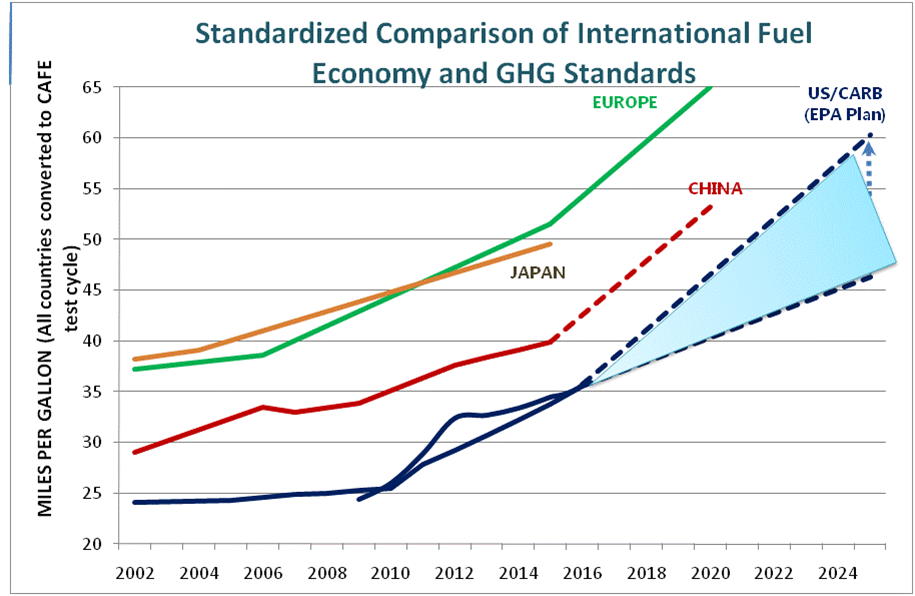
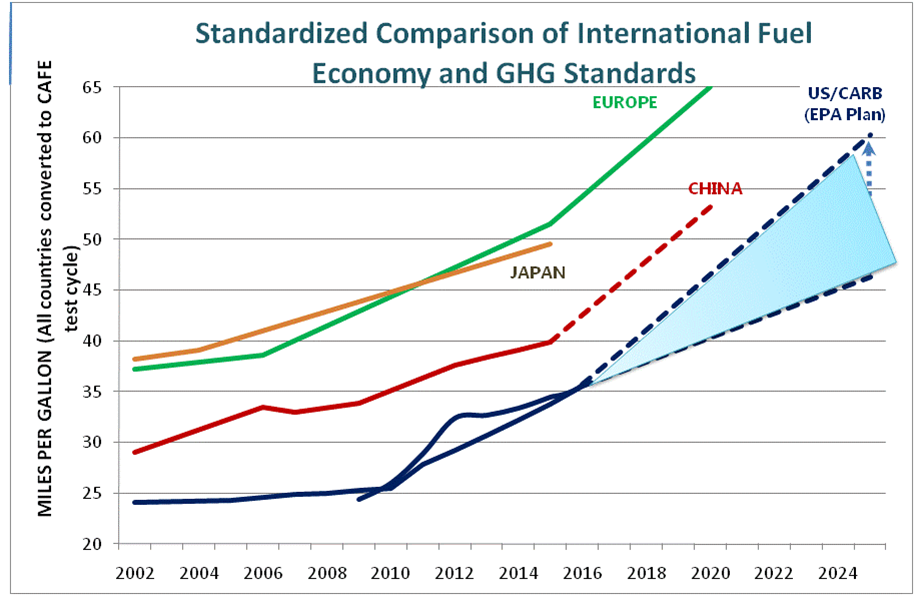
Under the 12th Five Year Plan, China will begin to implement a national cap-and-trade program for greenhouse gases, something that was a high priority during the Obama presidential campaign, but which has turned into a political flop in Washington. And there are hundreds of new standards and regulations put into effect every month in Beijing to increase the energy efficiency of appliances, buildings, fuels and vehicles. For example, below is a chart of fuel economy standards for vehicles in different regions around the world. China ranks below the EU and Japan, but ahead of the US and Canada.

Source: Dr. Feng An, Innovation Center for Energy and Transportation, ©2011.

All this must be taken with a pinch of salt. While China is encroaching on the US in key technological areas, it is far from unseating the world’s superpower. Other key indicators demonstrate this. For example, China’s military is Lilliputian compared with the US. Last year China’s military budget was $77.97 billion, less than one-eighth of the US’s $663.8 billion budget. And the US economy still towers over the world: US nominal GDP in 2010 was $14.62 trillion to China’s $5.76 trillion.

China remains firmly in the category of a “developing” country. With a population five times larger than the US, per capita GDP (PPP) was $7,400 in 2010 ranking it 127th in the world according to the CIA World Fact Book (the same GDP measurement for the US was $47,400, the 10th highest in the world). While 76.7% of the US GDP comes from the service sector, over half (56.4%) of the GDP in China comes from industry and agriculture. The lesson here is that while China is making big strides, it is still a developing economy and far behind the US in key areas. China might have the fastest computer, but it is one of the only countries in the world which still manufactures the ox-drawn plow.

By Lucia Green-Weiskel and Tina Gerhardt

Originally Published in the Huffington Post

The most concrete goods delivered by last week’s bilateral state summit between President Obama and China’s President Hu Jintao came not from heads of state but from CEOs, as US and China-based businesses signed a deal through which China agreed to buy $45 billion worth of American exports.

President Obama argued that these deals would create jobs the U.S. but as Robert Reich reported, that’s not exactly right: “It will create more profits for American companies but relatively few new jobs.”

“Clean energy” companies signed most of the deals. On Tuesday and Wednesday, the Brookings Institution and the China Institute for Innovation and Development Strategy hosted a series of meetings on the “US-China Strategic Forum on Clean Energy Cooperation” in conjunction with the summit.

China’s VIPs included CEOs from the largest coal and nuclear companies: Wang Binghua from State Nuclear Power Technology Corporation; Zhu Yongpeng from Guodian Corporation, one of China’s largest energy companies; and Zhang Xiwu from Shenhua Group, China’s largest coal company. US guests of honor included James E. Rogers, CEO of Duke Energy; Aris Candris, CEO of Westinghouse; and Michael Morris, CEO of American Electric Power.

A number of agreements and memorandums of understanding came out of these meetings. GE signed a letter of intent with China Ministry of Railways, expanding on a preexisting agreement to bring China’s technology to the US, in order to build high-speed railways — a goal mentioned in Obama’s State of the Union address.

US-based Westinghouse Electric signed a memorandum of understanding with two of China’s leading nuclear power companies, in order to develop nuclear power capacity in both countries.

Several companies, including U.S.’s Duke Energy and China’s ENN Group, signed agreements to develop and implement “clean coal” technology.

Companies that were given a presidential nod when they were invited to the White House’s Wednesday evening state dinner for Hu included Goldman Sachs, JP Morgan, Chase, Microsoft, Boeing, the Carlyle Group and GE.

GE’s position of influence has grown, not only through the letter of intent it signed with China, but also because — amidst the US-China summit — President Obama appointed GE CEO Jeff Immelt to head his economic advisory panel, a position formerly held by Federal Reserve chair Paul Volcker.

During the forum co-hosted by the Brookings Institute and the China Institute Innovation and Development, last week US Secretary of Energy Steven Chu and his counterpart Zhang Guobao from China’s National Energy Administration hosted a signing ceremony for the US-China Clean Energy Research Center.

A $150 million dollar initiative of the US’s Department of Energy and China’s National Development and Reform Commission, the center will facilitate mutually beneficial agreements between US and Chinese companies and will focus on energy efficiency, clean coal and electric vehicles.

Events associated with the ceremony emphasized more how to use fossil energies efficiently and less how to connect renewable energy to the grid. Clean technologies and renewable energy were crowded into one session, cut short when Chinese investors stated that the US does not invite investment in clean technologies and renewable energy: it sends inconsistent policy signals and lacks incentives for the development of renewable energy.

Signs affirming that China’s policies for investment in renewable energy are more coherent and long term than the US’s have been evident in recent weeks. Solar panel maker Evergreen announced recently that it would shutter its main plant in Massachusetts, laying off 800 workers, and moving production to China. The reason? China’s government provided much higher subsidies of solar energy.http://www.nytimes.com/2011/01/15/business/energy-environment/15solar.html

Earlier this week, the American Wind Energy Association announced that China has become the leader in wind energy capacity, seizing the lead from the US. According to the wind industry, US wind power in the US is hampered by uneven incentives: a lack of consistent and reliable federal policies on and subsidies for renewable energy.

Instead of taking the opportunity to up the ante of a US commitment to renewable energy by setting strong policy signals, Obama has largely left energy discussion to CEOs. The announcement on Monday of the departure of Carol Browner, his senior climate and energy policy adviser, has only increased concerns among environmental groups about the president’s commitment to passing a climate bill, establishing a nationwide renewable portfolio standard (RPS). (China, like the EU, has established renewable targets. The U.S. has yet to set such domestic targets.)

While partisan divides are cutting deeper into American politics, one area where the left and right seem to get along is China bashing.

Pundits from both the right and the left accused Obama of coddling a dictator, pointing to the lavishness of the state dinner, Michelle Obama’s “commie” red dress and Sasha Obama’s eagerness to learn Chinese as evidence.

From Democrat Senate Majority Leader Harry Reid to Human Rights Watch and from Republican Speaker of the House John Boehner to Rush Limbaugh, the message was clear: China abuses human rights and is stealing our jobs.

In his State of the Union address, Obama stated that subsidies for oil companies will end and that the US will get 80% of its energy from clean sources by 2035. Without aggressive government investment and strong policy signals, it remains unclear how to get from here to there.

Tina Gerhardt is an academic and journalist.
Her writing has appeared in Grist, The Huffington Post, In These Times and The Nation.

Lucia Green-Weiskel is Project Manager of the Climate Change Program at the Beijing-based independent Innovation Center for Energy and Transportation (iCET).  Her work has appeared in Chinadialogue.net, Grist, The Huffington Post and The Nation.

// <![CDATA[
document.write('');
document.write('');
var debugadcode = '';
document.write(debugadcode);
// ]]>

By Lucia Green-Weiskel and Tina Gerhardt

Originally Published on Alternet

In China, a race toward self-reliance and clean energy technology is certainly on, but the U.S. still needs to make some key changes if it wants to compete.

Next week, January 19 to 21, President Obama will host Chinese President Hu Jintao for their first bilateral summit this side of the Pacific. According to former National Security Adviser Zbigniew Brzezinski, this “will be the most important top-level United States-Chinese encounter since Deng Xiaoping’s historic trip more than 30 years ago.” While economic and military issues will be on the agenda, a key part of the meeting will be energy. U.S. Secretary of Energy Steven Chu has suggested that a Sputnik-like race for clean energy between China and the U.S. may be emerging. If so, how can the U.S. get in the game, given the current political climate in the country?

U.S.-China relations have been rocky over the past two years. At the United Nations climate conference in Copenhagen in 2009, China and the U.S. wound up at a standoff in the summit’s final hours.

Tensions hinge on who should take responsibility for the bulk of the emissions. The U.S. blames China, a growing economy and the world’s largest emitter of greenhouse gases, while China blames the U.S., the largest emitter historically and the larger emitter on a per capita basis, by far.

The original UNFCCC charter from 1992 stipulates that developed nations, such as the US, lead the world in fighting climate change, since they bear historical responsibility for producing it. The 1997 Kyoto Protocol echoes and expands this concept, calling on countries to act with “common but differentiated responsibilities,” which means while all nations are “responsible,” each nation acts according to its ability based on its level of development.

This statement has caused considerable tension between the U.S. and China. While the U.S. rejects “common but differentiated responsibility” and insists that China must step up to the plate, China believes that developed countries should take the lead.

From recent UN negotiations in both Copenhagen and Cancún, it is clear that the U.S. wants an agreement that has “symmetry” — one that includes reductions commitments from developed and developing countries. China, for its part, is willing to make voluntary commitments but insists that the U.S. sign on to a legally binding agreement.

Additionally, concerns at the UN climate talks revolve around how emissions reductions commitments will be monitored, reported and verified.

Closely linked to the energy issue is the problem of economic protectionism. Last September, the U.S. United Steelworkers (USW) filed a 5,800-page complaint against China with the U.S. Trade Representative, arguing that its renewable energy subsidies violated international trade regulations. The complaint followed on the heels of a call by environmental groups and politicians for higher tariffs to be imposed on China-produced high carbon imports.

In December, Obama sided with the United Steelworkers, filing a complaint with the WTO against China’s wind power subsidies and leaving Chinese officials feeling snubbed and victims of a no-win American policy.

According to Dale Jiajun Wen, a scholar at the California-based International Forum on Globalization: “The recent complaints filed by the U.S. union have further consolidated the impression by many Chinese that the U.S. has no real concern for the climate but is only using it as a China-bashing tool. The inconsistency of the U.S. climate and trade policy is too obvious to ignore.”

The protectionist tendencies continue unabated: Last week, Obama signed a military authorization law that includes a “Buy American” clause, prohibiting the U.S. Department of Defense from purchasing solar panels made in China and undoubtedly dismaying Chinese officials.

Given these tensions, it remains to be seen what agreement the U.S. and China will reach at the upcoming Washington summit. Last week, Obama announced a shuffle in his Asia and China teams at the National Security Council and State Department in an attempt to hit the reset button on U.S.-China relations.

And Energy Secretary Chu recently framed the new relationship between the U.S. and China as a “Sputnik Moment.” Referencing the first satellite launched by the Soviet Union in 1957, which demonstrated its technological advantage and led to the Cold War-era space race, Chu warned that the U.S. risks falling behind China in the clean technology race.

U.S. Secretary of Commerce Gary Locke already noticed this trend in 2009 when he said, “Ten to fifteen years from now, we’re going to be saying, ‘How did Shanghai become the Silicon Valley of clean energy?’”

Yet whether this new clean technology race pits the U.S. against China competitively, as the Cold War-era space race did, or allows for scientific partnerships between the U.S. and China remains an open question.

The new joint U.S.-China Clean Energy Research Center (CERC), which will be featured at next week’s meeting, forms one sign of collaboration. The center will facilitate joint research and development on clean energy. Priority topics include building efficiency, clean coal, carbon capture and storage, and clean vehicles. Despite this sign of cooperation, the U.S. and China have exhibited remarkably different approaches to the development of clean technology and how to transition from a fossil fuel-based economy to one predominantly reliant on renewable energy.

Although historically China has relied on coal and hydropower for its electricity, it is investing in renewable energy at breakneck speed.

Currently, 70 percent of China’s economy is coal-powered. But policy changes are afoot. Although it is not an official figure yet, China’s energy bureaucrats seek to drop coal reliance from 69 to 63 percent by 2015. According to Zhang Guobao, Director of China’s National Energy Administration, China has saved more than 300 million tons of coal in the past five years by replacing dirty and outdated thermal power plants.

Another new policy puts forth that 15 percent of China’s energy must be derived from renewable energy. In addition, China’s new energy policies focus on energy efficiency compliance, considered a green technology in China.

China’s ramped up clean technology also draws on renewable energy. A 2007 report released by the World Watch Institute stated that “China has become a global leader in renewable energy.” Its renewable energy sources encompass biomass energy (derived from sugarwastes and rice husks) and biofuel (produced mainly from corn), as well as solar and wind power. (In China, nuclear energy is not included as a renewable as it is in the U.S.)

Overall, China is the world’s biggest manufacturer of solar panels. Suntech Power in Wuxi is the world’s third largest producer of solar power. Moreover, while China produced 50 percent of the world’s solar panels in 2010 it receives about 2 percent of its total energy from solar. Under new aggressive government plans for investment in renewable energy, however, this number will likely grow rapidly. In Rizhao, a city in northern China, 99 percent of households use solar water heaters.

Recently, an Arizona-based company, First Solar Inc. signed a deal with China Guangdong Nuclear Solar Energy Development Co., a Chinese state-owned energy company to build one of the world’s largest solar power facilities in Inner Mongolia.

Wind power has also seen dramatic increases in China in the past five to six years. The wind industry has doubled in size each year since 2004. And as the New York Times reported just this week: “More than three times as much wind power capacity was installed in China last year than in the United States.”

Here, too, policy played a strong role. Greenpeace’s Li Yan told AlterNet that “a law required that 70 percent of wind had to be manufactured domestically. This stipulation helped to create jobs and to boost China’s wind power, which has overtaken other previous leaders, such as Denmark, Spain and Germany to take the number one spot.”

Challenges to China’s wind economy remain. According to Li Yan, “If one talks about the installation capacity, China will probably be number one by the end of this year or next year, but if we talk about wind energy that has been connected, then we are still far behind.” While installation occurs more quickly, connecting, according to Li Yan, remains slowed by the centralized state owned energy structure, which has created a bottleneck.

Li Yan’s concern pinpoints one of the potential pitfalls of the China’s implementation strategies: strong policies at the central level do not always translate well into solid implementation at the regional level.

In March, China will release the 12th Five Year Plan (2011-2015), which will set new renewable energy targets. The plan calls for deep cuts in energy-intensity and large subsidies to bring renewable energy and electric vehicles to scale. It includes both a cap and trade program and carbon taxes. And it requires utilities companies meet energy-saving targets and invest electricity revenues in renewable energy. Additionally, China has announced that it will produce a nation-wide greenhouse gas inventory by 2012 — its first since 1994. Producing such an inventory of greenhouse gases requires a sophisticated ability to measure emissions from a variety of sources.

While implementation remains a challenge, many of these targets are being met. For example, China’s National Development and Reform Commission recently announced that it will meet its target of reducing total pollution by 10 percent from 2005 to 2010. Last year, the Chinese government ordered blackouts in many parts of China in order to meet another target to reduce energy intensity by 20 percent by 2010 from 2005 levels.

Thus in China, a race toward self-reliance and clean energy technology is certainly on, even if it the Sputnik Moment race itself is a U.S. construct. Chu, like China, seems to be taking the long view of the environmental and economic situation.

In the U.S., renewable energy still needs to be made cost competitive. A number of measures could help to develop and make renewable energy affordable: 1) feed-in-tariffs; 2) subsidies; 3) tax credits; and 4) state regulations provide renewable portfolio standards (RPS), that is, demand that a specific percentage of their energy, typically 4-30 percent, be derived from renewable energy sources by a specific date.

A feed-in-tariff system — the first of these incentives — allows homeowners, who have installed solar panels, to sell back to their utility company the excess amount of energy produced, thereby reducing their overall electric bill. As of 2009, 11 states were considering legislation to permit feed-in-tariffs in the U.S.

Subsidies in the United States often heavily favor fossil fuels. This predilection leaves renewable energy, which has been growing nonetheless, artificially gummed up in the U.S. Subsidies for renewable energy could encourage a shift in the base.

Tax credits for production of renewable energy are also extremely beneficial. Thus far, growth in wind farms has been astronomical as a result of the Recovery Act or tax credit 1603.

Michigan is second nationwide for wind manufacturing and just announced another new plant. Its success comes as a direct result of grants from the U.S. Department of Energy. Additionally, Recovery Act funds help businesses diversify into clean energy through the Clean Energy Advanced Manufacturing program. And a state law enacted by Governor Jennifer Granholm in 2008 requires 10 percent of the state’s energy to come from renewable sources by 2015. Due to these subsidies and laws, the U.S. Department of Energy projects that Michigan will create 30,000 more jobs in the wind-manufacturing sector.

The results of all this investment into wind in the U.S. are already upon us. Texas, Iowa and California lead the country in installed wind capacity. To date, 20 percent of all energy in Iowa comes from wind; it marks the largest growth over the past year. In Texas, 25 percent of all energy comes from wind power. Wind farms in the Southwest and off the coast in the Atlantic have also ramped renewable energy sources. Across the country, wind as a source of renewable energy has increased four-fold over the past decade.

During the UN negotiations in Cancún, it was announced that the Recovery Act 1603 tax credit for renewable energy would not be extended. Peter Kelley, of the American Wind Energy Association, told AlterNet, “what this means is that the growth we have seen in wind in the past few years, which grew 20 percent in 2008 and 40 percent in 2009, is set to decrease by 45 percent due to the expiration of this tax credit.”

Kelley is not only concerned about the environment. He sees the relationship between renewable energy and the economy, and specifically, job opportunities. “The wind energy industry,” he added, “kept 85,000 people in jobs during this economic recession. As a result of this tax credit expiring, tens of thousands of layoffs will occur.”

Yet Kelley’s view that tax subsidies produce jobs differs sharply from the views of some Republicans who took control of the House of Representatives last week and were quick to dissolve the Global Warming Committee, established by Speaker Nancy Pelosi (D-CA) and Representative Edward J. Markey (D-MA) in 2007. They refer to the national energy tax not as job inducing but as a “job-killing national energy tax.”

“We have pledged to save taxpayers’ money by reducing waste and duplication in Congress,” said Michael Steel, spokesman for incoming Speaker John Boehner (R-Ohio). “The Select Committee on Global Warming — which was created to provide a political forum to promote Washington Democrats’ job-killing national energy tax — was a clear example, and it will not continue in the 112th Congress.”

It remains to be seen what results Chu’s ramped-up program will have for the economy and the environment. Given last week’s changes in the Obama administration and at the helm of the House, will the Department of Energy be able to ring in a new era committed to clean technology and renewable energy? Will it be able to be competitive in a renewable energy race?

In light of Hu Jintao’s visit to Washington, the Sputnik Moment proclaimed by Chu could herald either a new era of cooperation, or of competition.

Tina Gerhardt is an academic and journalist whose writing has appeared in Grist, The Huffington Post, In These Times and The Nation. Lucia Green-Weiskel is Project Manager of the Climate Change Program at the Beijing-based independent Innovation Center for Energy and Transportation (ICET). Her work has appeared in Chinadialogue.net, Grist and The Nation.

© 2011 Independent Media Institute. All rights reserved.
View this story online at: http://www.alternet.org/story/149507/

originally published in The Nation here.

Lucia Green-Weiskel | December 16, 2010
Cancún

Just after 3 am on the last day of the UN climate change conference, exhausted negotiators from 193 countries signed an agreement that was modest and reflected elements of desperation (the one country refusing to sign, Bolivia, decried what it called “a hollow and false victory” that would fail “to prevent runaway climate change”). After the failure last year in Copenhagen, the UN-led talks were falling apart, with some beginning to suggests that the issue be handled outside the UN, either by bottom-up approaches or in more elite groups like the G-20. The Cancún Agreements are significantly less ambitious than what many observers had hoped for, but at least they avoided collapse. The failure in Copenhagen and Cancún to agree on binding emissions-reduction targets marks a significant scaling back from the 1997 Kyoto Protocol, the first and only international agreement to set legally binding targets.

In lieu of binding targets, the Cancún Agreements address technical issues like transfers of green technology to developing countries and a reiteration of the domestic reduction plans initiated in previous talks. The documents postpone, until next year’s conference in Durban, South Africa, the contentious issue of whether to extend Kyoto, which expires in 2012. Instead they call for establishing a $100 billion fund to help developing countries adapt to climate change. But that fund will be managed by the World Bank, which has a dismal record on environmental protection. And it is still not clear where the money will come from.

“It is not what is ultimately required, but it is the essential foundation on which to build greater, collective ambition,” said Christiana Figueres, executive secretary of the UN process, formally known as the UN Framework Convention on Climate Change (UNFCCC). Between pleas for progress, Secretary General Ban Ki-moon had to resort to a tired cliché to describe the mood: “We cannot let the perfect be the enemy of the good.” By producing an agreement, the Cancún delegates partially restored the credibility lost at Copenhagen.

A key question about Cancún was whether the world’s biggest emitters, the United States and China, would come any closer to a common understanding on who is responsible for the climate problem and what to do about it. The two countries together account for 30 percent of the world’s economic output and 40 percent of greenhouse gas emissions from fossil fuels. The US and Chinese negotiators at Cancún were crafty and subtle. Both teams used cautious language that on the surface appeared to present similar positions. Both wanted a deal and both wanted to be seen as playing a constructive role—but each saw the other as an obstruction to progress.

When Dr. Yang Fuqiang, director of Global Climate Solutions for WWF International, arrived in Cancún, his hopes were dim that the United States and China would reach a meaningful agreement on reductions. With more than thirty years of experience working on energy and environmental issues in China, Yang has attended the three most recent of the UN’s sixteen rounds of climate negotiations. China, he said, would only accept an agreement that allowed exemptions for developing countries—the concept known as “common but differentiated responsibilities,” which is the bedrock of the Kyoto Protocol. In this claim, China is aligned with Article 3.1 of the UNFCCC charter, which states, “The developed country Parties should take the lead in combating climate change and the adverse effects thereof.”

Throughout the meetings, the US deputy special envoy for climate change, Jonathan Pershing, expressed plans to scrap Kyoto—not surprising, since the United States is the only developed country that has not signed it. Washington wanted to draft a new agreement that has “symmetry”—one that is legally binding for developed and developing countries. As Pershing explained in a briefing to NGOs, the Obama administration can’t sell a package in Congress that doesn’t include specific requirements for developing countries like China.

By the end of the conference, it was clear that both delegations were oriented toward domestic regulators more than anything else. The chief negotiators, Xie Zhenhua and Todd Stern, read the same document but reported on it in completely different ways. Xie told China’s Xinhua news agency that the Cancún Agreements uphold the Kyoto Protocol and reaffirm the principle of differentiated responsibilities. Stern told a press conference that the Cancún Agreements build on the 2009 Copenhagen Accord (widely viewed as the document that undoes Kyoto) and reflect progress toward firmer commitments from all nations, developed and developing.

From the beginning, the UNFCCC process has been marred by a sharp divide between developed and developing countries. Key developed countries hold the view that the developing world, where energy consumption is accelerating, should be bound by firm targets. The position of the developing countries, which China firmly promotes, distinguishes between luxury emissions and sustenance emissions, arguing that the latter are required for economic development and to alleviate pressing problems such as poverty and inadequate infrastructure.

In Copenhagen Chinese negotiators were eager to point out that although China is the world’s largest emitter of greenhouse gases on an annual basis, its per capita emissions remain much lower than those of America (and America is still the world’s largest climate polluter on a cumulative, or historic, basis). In addition, they point out, almost a quarter of China’s emissions come from the manufacture of products sold in the West, a fact that leads many in China to argue for a consumption-based rather than a production-based approach to emissions quantification. Given this different view of the accounting process, China prefers to use its own domestic mechanisms to set and meet targets outside the UN system.

US-China tension erupted during the debate over measuring and verifying emissions. In UN parlance this is called MRV, or measuring, reporting and verification of greenhouse gas emissions. MRV, where the treaty details are actually spelled out, is what gives the agreement meaning and power and thus is also the area that can cause the greatest turbulence. It is to climate change what the 1040 is to taxes, an agreed methodology that makes clear what is and what isn’t included in a carbon footprint, at the individual, corporate or national level. Too technical for nonexperts, MRV helps standardize quantification and ensures that a ton of CO2 in France is equal to a ton of CO2 in China or the United States.

The United States and China have agreed on how to do the M (using criteria established by the International Organization for Standardization) and the R (with domestic mechanisms and answering to local or central governments). But there is serious dispute over verification, and who has the authority to determine what constitutes an “avoided” ton of carbon—that is, carbon that would have been released into the atmosphere but was not because of national policies that promoted cleaner technology. The United States insists that emissions reductions not transparent and verified by international inspectors are not valid. For China, this is an example of how the United States has politicized the climate talks. Beijing views calls for inspections and “more transparency” as an infringement of its sovereignty and alleges ulterior motives aimed at destabilizing its government. From China’s perspective, the US demands on verification are less about climate change than about the American establishment’s desire for China to adopt Western-style democracy and transparency.

The tension was evident at an intercessional meeting in Tianjin in October, when Xie’s deputy, Su Wei, met with his US counterparts. In Copenhagen, Vice Foreign Minister He Yafei had said Stern “lacked common sense.” In Tianjin, the vitriol continued when Su said Stern (in absentia) was like a “pig preening itself in the mirror,” a reference from an ancient Chinese legend that implies hypocrisy and gluttony. (I was later told by a Chinese friend that this episode was misunderstood in the US media and that two different but similar idioms were confused.)

Perhaps it was the paradisiacal quality of the turquoise beaches and the ubiquitous margaritas, but there was clearly a warming of relations at Cancún. Yang Ailun of Greenpeace noted that the Chinese delegation chose to focus on what it could offer rather than what it would oppose. This new posture marks a clear departure from its negotiating style at Copenhagen and Tianjin. But the new tactics do not reflect a new position. China’s stance in Cancún—that its voluntary reductions could be part of a global agreement if the United States adopts a legally binding commitment—is a new arrangement of its previous position. The fact that the United States, given its domestic political climate, will probably not adopt a legally binding agreement renders the Chinese offer moot. It shows, however, that China is becoming a more sophisticated negotiator and more adept at public relations.

Su Wei, second in command of the Chinese delegation after Xie, opened the conference by declaring that China would play a “constructive role” in the talks. In the first week he announced that the differences between the United States and China were not significant. Then, to the shock of many, he said casually, “We have no problem with MRV.” This statement struck many as a reversal of China’s Copenhagen position, which had been vigorously against the MRV process. But, as Yang explained to me, when the United States and China speak about the MRV process, they have different ideas about what it means—and it is precisely these differences that prevent agreement on the fundamental issues of climate change.

To find out more about the MRV process, I talked with Lo Sze Ping, who has worked on China’s climate policies with Greenpeace and on greenhouse gas accounting with the Beijing-based Society of Entrepreneurs and Ecology. Lo attended the Cancún conference as a member of Green China: Race to the Future, a consortium of Chinese and international NGOs, including Greenpeace and the Natural Resources Defense Council, which are raising awareness about the importance of climate change. In Cancún, they published a position paper calling on the Chinese and other governments to take stronger action to fight climate change. “China is playing hard on the MRV issues technically not because they are against it but because this is the issue where the United States is poking China,” Lo explained. “From China’s point of view, there are two issues.

The first is the issue of not making MRV references to finance and technology. The US demands aren’t backed with money. It is entirely unclear where the financial resources will come from to support the reductions that the developed world is asking of developing countries. The developed countries are pressuring developing countries to become more transparent, but the issue of funding from developed countries is far from transparent.” Indeed, developed countries have not been clear about where the
$30 billion in fast-track funds will come from or how they will be allocated. Although promised in Copenhagen for the period of 2010–12, less than half of the money has materialized.

“The second issue,” Lo continued, “is that developing countries are not happy with the insufficient ambitions from developed countries regarding their own reduction plans for the medium term [up to 2020]. What is on the table from developed countries does not add up to what is required by science.” This point leads China to believe that the United States is not willing to accept its share of climate responsibility. “Developed countries didn’t show sincerity in their response, and now they are asking the developing countries, like China, to do more than what is required by the Kyoto Protocol,” said Lo.

And this is where MRV comes in. The United States understands that process as a rigorous mechanism for reductions that should be applied in the same way to all countries, developed and developing. In the US view, MRV should have universal application, in which international inspectors with official access to the domestic activities of a country can verify reports of reduced emissions. Chinese negotiators view the US interpretation of MRV as a way of reversing the “common but differentiated responsibilities” clause in the Kyoto Protocol. “China believes we should not be renegotiating the mechanisms of the Kyoto Protocol; instead, we should stick to the Kyoto Protocol and negotiate just the second commitment period targets for each country,” Lo explained. “MRV could be used as the Trojan horse to dismantle the Kyoto Protocol.” For China, the MRV process functions as a domestic tool to quantify and verify emissions and reductions—an accounting instrument that China has already adopted. To Beijing, MRV and “differentiated responsibilities” are not mutually exclusive.

After sixteen climate change meetings, beginning with the first conference in Berlin in 1995, the United States and China are still unable to get beyond the dilemma of how to quantify emissions and determine who is responsible for reducing them. To progress, the United States would have to show China it has adopted a national plan for emissions reductions, such as cap and trade. As long as America forgoes domestic climate legislation, China is likely to doubt the sincerity of US action. Now, with recent GOP victories in Congress—86 percent of the incoming Republicans oppose government action on climate change—and noise from Tea Partiers (only 8 percent of whom believe global warming is caused by human activity), the United States appears to be retreating from climate legislation.

While US green ambitions are shrinking, China is reorienting its economy toward sustainability and renewable energy in a way that is nothing short of revolutionary. It has invested billions in renewable energy, energy efficiency, public transportation (the Chinese bullet train made headlines by reaching a record 300 mph during the Cancún talks) and developing standards for products, buildings, vehicles and fuels. In July Xie announced that a cap-and-trade system would be included in China’s twelfth five-year plan (2011–15). In September China’s most powerful agency, the National Development and Reform Commission, announced that China was setting up low-carbon pilot sites in five provinces and eight cities. One focus is to implement methods to measure, report and verify emissions. These events are an indication that China’s lead over the United States in green technology will likely increase in the coming years.

Green technology is still a boutique industry in the United States, while China is producing it on a massive scale. Through aggressive government investment and central planning, Beijing has become a leader in solar panel technology, wind turbines and electric vehicle manufacturing. In fact, it is emerging as the only country in the world capable of driving down the price of green technology so that it can become affordable in poor countries in Asia, Africa and Latin America.

However, China’s government-led policies have met with hostility in the United States. Earlier this year the United Steelworkers filed a 5,800-page complaint with US trade representatives, stating that China’s subsidies of green technology were illegal and unfair. From the Chinese perspective, this is a no-win paradigm: if China doesn’t invest in a cleaner economy, US lawmakers threaten to slap a high-carbon tariff on Chinese imports. But if China takes the environmental issue seriously and invests in renewable energy, US lawmakers threaten to punish China for “unfair” trade practices. Without prospects for a US-led agreement for emissions reductions at the UN, China has become a scapegoat in the US media and among US politicians. China-bashing is at an all-time high. In the recent midterm elections, an astonishing twenty-nine candidates used anti-China messages in campaign ads.

Dr. Dale Jiajun Wen is a Chinese citizen who watched the US-China negotiations from San Francisco, where she is China Scholar at the International Forum on Globalization. “The US failed to pass crucial climate legislation. Meanwhile, it has been seeking to divert attention away from its own failures by pointing fingers at China,” she says. “The Chinese people are asking the US to stop using China as an excuse for its own inaction.

“China is very serious about its targets,” she continues. “In recent months, in the final push to achieve its domestic energy efficiency target for the eleventh five-year plan, not only were some factories shut down but also some residential areas experienced blackouts. Have any Annex 1 [developed] countries had blackouts in order to comply with Kyoto targets? Yet in most discussions about transparency in Western media, China is presumed guilty. In Bali [the thirteenth climate change conference, in 2007], the United States was told, ‘If you are not willing to lead, then get out of the way.’ To give it fair credit, the Bush government did get out of the way and allowed the world to move forward with the Bali Action Plan. Now it is again time to ask the United States to get out of the way if it cannot lead.”

Check out my half-hour interview on Doug Henwood’s show Behind the News. Click here to stream or download podcast.

Recent article in Grist co-authored with Tina Gerhardt

see original post here

Last week, in a move that pits American labor against China’s green-technology industry, the Obama administration filed a complaint with the World Trade Organization over China’s wind-power subsidies.

The U.S. move challenges China’s rapid growth in the renewable-energy market, and also throws the weight of the administration behind the unions, elevating concern about Chinese competition to the level of official U.S. policy.

The complaint falls on the heels of a 5,800-page filing made in September by the United Steelworkers against China, arguing that its renewable-energy subsidies violate international trade regulations. According to that filing, China defied trade agreements by providing land grants and low-interest loans in order to produce clean technology at artificially low prices.

Both complaints ignore the fact that energy industries all over the world benefit from government subsidies. In the U.S. and Europe, the nuclear and fossil-fuel industries get massive public subsidies. And as a percentage of GDP, Spain and the U.K. pump funding at levels similar to China’s into green subsidies.

China sharply rejects allegations that its rapidly growing solar-panel and wind-turbine manufacturing efforts defy WTO trade regulations.

Beijing dismisses the attacks as another example of China-bashing, which rose to new heights in the U.S. during the recent 2010 midterm elections, when no fewer than 29 congressional and gubernatorial candidates pushed anti-China messages in campaign ads. In October, The Wall Street Journal reported that “China is emerging as a bogeyman this campaign season, with candidates across the American political spectrum seizing on anxieties about the country’s growing economic might to pummel each other on trade, outsourcing and the deficit.”

The Obama administration appears to be taking a cue from this surge of protectionist scapegoating.

China, for its part, feels it is being presented with a damned-if-you-do-and-damned-if-you-don’t set of options. If the country invests in clean technology, U.S. officials claim China is engaging in “unfair” trade practices. If it does not, U.S. lawmakers threaten to slap a high-carbon tariff on Chinese imports. It’s a no-win situation.

China is actually doing the world a favor. Its renewable-energy subsidies, which have made it a leading producer of wind and solar technology, are one of the most encouraging signs of progress in the global fight against climate change. China is currently the only country producing green technology at a scale that could dramatically bring down the price of goods like solar panels and wind turbines, making them affordable for both the developed and developing world. These advances could not have been brought about without government subsidies.

China‘s leaders have also committed to ambitious carbon-reducing policies. The country is aiming to cut its greenhouse gas emissions per unit of GDP by 40 to 45 percent from 2005 levels by 2020. And it is committed to deriving at least 15 percent of its energy from renewable sources by 2020.

China is now the world’s largest emitter of greenhouse gases, but it still ranks far below the U.S. in terms of per capita emissions and historical emissions. And almost one-quarter of China’s emissions come from products that are made for export. To the extent the country becomes a major exporter of wind turbines, solar panels, fuel cells, and electric vehicles — all of which are energy-intensive to produce — it will be taking on an emissions burden from other countries.

If the U.S. wants to get serious about renewable energy, it should ramp up its own subsidies for clean technology, not quibble over China’s.

Lucia Green-Weiskel is project manager of the climate change program at the Beijing-based independent Innovation Center for Energy and Transportation. She appeared on Democracy Now during the COP 15 in Copenhagen and the COP 16 in Cancun, and her work has been published in The Nation.

Tina Gerhardt is an independent journalist and academic who covers climate change and environmental politics. Her work has appeared in Alternet, Grist, The Huffington Post, In These Times, The Nation, and Salon. Most recently, she covered the COP 16 climate meeting in Cancun for Alternet and The Nation.

I haven’t written in a while because I have been at the United Nations climate conference — the COP16 — in Cancun. The conference closed last night with a modest deal reached. Although many are viewing the fact that a deal was reached as a success, it appears  at first glance that the terms of the deal are so scaled back that it can hardly be considered a successor to the much more ambitious Kyoto Protocol which will expire in 2012.

Parties overcame resistance from the Bolivian delegation on Friday night and a deal was announced yesterday morning. The “Cancun Agreements” are not legally binding and do not include emission reduction targets for any country. This is a scaling down from the Kyoto Protocol which included targets for developed countries and it is much less ambitious than the deal many observers hoped for over a year ago in the lead up to the widely publicized Copenhagen talks. Bolivian delegates pointed out that the Cancun Agreements allow for a 4 degree Celsius rise, enough to destroy croplands, displace billions of people as land becomes submerged resulting in food insecurity and massive influxes of refuges.

In lieu of outlining binding targets for reductions, the Cancun Agreements deal with technical issues such as a $100 billion fund to help developing countries mitigate the effects of climate change (although its still not clear where the money is coming from), technology transfer and how to measure, report and verify reductions.

By producing an agreement, many journalists noted, the climate talks process under the UNFCCC, which lost credibility after the failure to do anything in Copenhagen, was restored.

There were many discussions about alternative venues for the global talks. Some promoted sub-national agreements as a more realistic format. Others said the climate issue should be thrown to the G20. Still others said the UN was the only forum that should deal with the climate issue because of its unique democratic and transparent quality.

The climate issue is very tricky — the atmosphere is like a stew, ignoring the invisible national boundaries that are so important in issues like trade, human rights and economic development. The problem is caused by economic activity taking places in almost infinite locations around the world and all people will suffer the consequences. Yet, as many have pointed out, the people who are most responsible for climate change are least vulnerable to its consequences and the people least responsible are most vulnerable.

Like previous COPs, the main fault line in the Cancun talks was the divide between developed and developing countries with most developing countries calling for the continuation of the Kyoto Protocol which calls for stronger commitments from the developed world while developing countries are not legally bound to reductions AND key developed countries (the US, Japan and Canada) calling for a new agreement that would hold ALL countries responsible.

These issues will be dealt with again at the next round of talks scheduled for next year in Durban, South Africa.

My organization held three events during the summit.

The first is iCET’s Green Car Rating System launch held on Dec. 6th, 2010. The link can be found here.

[COP16, Cancun: China\'s Green Car Rating Launch, Dec. 6, 2010]

On Wednesday Dec. 8th, iCET held a press conference on the Energy and Climate Registry — China’s first voluntary greenhouse gas calculation and reporting platform. Link is here.

[COP16, Cancun, Energy and Climate Registry in China, Dec. 8th 2010]

There was no webcast for our two-hour side event.

I also did an interview on Democracy Now! on Liu Xiaobo and China’s position at the COP16.

YouTube Preview Image

Next week I will have an article in The Nation about why the US and China can’t agree on a legally binding deal to reduce carbon emissions.

(more…)

As I indicated in an earlier blog, most US president enter office with one view of China and leave with an entirely different perspective. Despite being the only president in history to visit China in his first year in office, Obama, so far, seems to be charting a different course, which is to sustain relatively bad relations with Beijing all along.

Here is a list of the contentious issues from most offending (to China that is) to least offending:

Currency Devaluation – It is the old familiar argument. Geithner and co. accuse China of unfairly manipulating its currency, the renminbi, to artificially lower the price of, and therefore boost, exports. This issue comes up almost any time anyone closely related to the Beijing or Washington circles come into contact with each other. And it has become the corner stone of Obama’s China policy (as well as that of almost all politicians, democrat and republican). China is skeptical of both the economics (number crunching) and the politics (face-saving move for recession-riddled US?) of the US position. Chinese official state that in previous rounds of devaluing the renminbi, instead of shrinking as predictions would have it, the US-China trade imbalance grew! On top of that, the US announces it is going to print more money to ease the recession. Currency manipulation? Sure looks like it. And the Chinese are quick to point out the hypocrisy.  I am not an economist. I am just pointed out the Chinese perspective. And if one is looking at the nature of US-China relations, perspective is pretty important.

Protectionism – In September the US Steelworkers Union filed a complaint to trade authorities about Chinese subsidies for renewable energy technology. Obama announced on October 15 that he would launch a federal investigation into the complaints. (I wrote about it here). From the Chinese perspective, this is a damned-if-you-do –and-damned-if-you-don’t approach. If China doesn’t invest in a cleaner economy than US lawmakers threaten to slap a high-carbon tariff on Chinese goods coming into the US. But if China takes the environmental issue seriously and invests in renewable energy, US lawmakers still punish China for “unfair” trade practices.

Climate Change – Lots of finger pointing going on here. The US portrays China as an irresponsible, industrializing, unregulated beast, hurdling recklessly toward modernization while belching pollution and climate change causing gases into an atmosphere that doesn’t acknowledge national boundaries. We won’t sign any international agreement that doesn’t also legally bind China to GHG reductions, says both Obama and his predecessor, George W. China has cooked up its own brand of “Chinese exceptionalism” stating that it should be exempt from regulations that might impede growth until they reach developed status.  China evokes the idea that there are “luxury emissions” (from SUVs, excessive business travel, oversized houses and malls etc) and “sustenance emissions” (emissions required to move from developing to developed status) – theirs being predominantly in the latter category and ours in the former. And finally China blames US overconsumption as the culprit for environmental woes, something which Obama has refused to accept.  In the end, it is a game of Chicken – each country wants the other to take the first step toward cutting emissions and pollution. However I should add there has been some nasty remarks exchanged in this game of Chicken. As I mentioned in a previous post, top Chinese climate negotiator Xie Zhenhua called his American counterpart, Todd Stern “ignorant” at the UN climate change conference in Copenhagen last year and earlier this year at the Tianjin intercessional UN climate summit, Todd Stern and co were referred to as hypocrites, specifically “pigs preening themselves in the mirror.”

Dalai Lama/ Liu Xiaobo – It might please Human Rights Watch and the Nancy Pelosis of the world, but Obama’s support for the Dalia Lama and democracy advocate and Nobel Peace Prize winner Liu Xiaobo has not helped grease the wheels of US-China relations. The Dalia Lama is viewed as Osama bin Laden lite in China and it does must to upset trust and good feeling between the US and China when Obama has official visits with the Dalia Lama as he did in February 2010. Another elbow jab came in the form of Obama extension of congratulations and recommendation that the state free from jail Liu Xiaobo, a little-known democracy advocate who won the Nobel Peace Prize last month. Among other undertakings, Liu is responsible for drafting Charter 08, a document calling for the democratization (read: overthrow) of the Chinese Communist Party. This made the Chinese government very angry. They even questioned the political neutrality and integrity of the Nobel committee.

UN Security Council Seat to India – In his recent trip to Asia, Obama made a big announcement that he would support India’s permanent membership on the UN Security Council angering both Pakistan and China, which both view US support for India in zero-sum terms. The move indicates a broader strategy in the Obama administration to prop up India as a counter balance or trade alternative to China, which Obama officials have expressed concern over becoming to dependent on.

Skipping Over China in Recent Asia Trip — Maybe not a big deal but it looks as if Obama did in fact pass through Chinese airspace on his way to Japan from India. True, Beijing was busy hosting UK Prime Minister David Cameron, but it could still be interpreted as a slight on China’s end.

Google — When Google pulled its operations out of China citing a lack of security regarding issues of privacy and intellectual property, Obama supported Google’s decision. At the time it seemed like a gratuitous poke at China but the impact of the initial blow it may have worn off by now. Baidu and other Chinese search engines have filled the Google vacuum, which wasn’t even that big in China to begin with.

Next week in Cancun, Mexico, US officials will again meet with their Chinese counterparts to discuss climate change at the UN climate conference. Without domestic legislation mandating national greenhouse gas reductions, Obama won’t be able to sign any legally binding agreement. It appears that this opportunity to improve relations may again be lost. But Obama still has 2 more years. Maybe his outlook on China will change – and like his predecessors he will enter office with one view of China and leave with that view entirely turned upside down.

In a particularly divided and hostile mid-term election, China-bashing is one of the only political issues that has enjoyed genuine bi-partisan support.

According to the New York Times:

“China is emerging as a bogeyman… with candidates across the American political spectrum seizing on anxieties about the country’s growing economic might to pummel each other on trade, outsourcing and the deficit.”

And the Washington Post:

“With many Americans seized by anxiety about the country’s economic decline, candidates from both political parties have suddenly found a new villain to run against: China.”

The same Times article quotes an astonishing statistic: “at least 29 candidates have unveiled advertisements suggesting that their opponents have been too sympathetic to China and, as a result, Americans have suffered.”

In the current political landscape where there are very few bipartisan life-rafts, politicians may increasingly cling to the one issue where everyone seems to get along. China-bashing could have a snow-ball effect – becoming bigger and stronger as it passes through the campaign and election cycles. A China Threat, already exaggerated and inflated by a gossipy and sensationalist media that rewards extremism would once more be compounded by the effects of a population that doesn’t seem to know a lot about China.

Just look at the inaccuracy of common China-related predictions from the last 30 years. In the 1980s after Deng Xiaoping came to power and initiated economic liberalization, foreign investment and the great to-get-rich-is-glorious reforms, many believed political reform was inevitable and so too would be the fall of the Communist Party in China. But that didn’t happen.

In 1990, after the global collapse of communism and the crackdown in Tiananmen Square, Communist China was the most politically isolated it had ever been in its short history. Many predicted it was only months before the Communist regime would crumble, which would cause China to break apart at its ethnically-drawn fault lines resulting in an independent Tibet, Taiwan, Xinjiang, Hong Kong, Macau and perhaps other regions that are now considered semi-autonomous.  Again, this never happened.

In the early 90s China’s economic growth rate skyrocketed but few people predicted it would last longer than a couple years. Yet, the growth spurt turned out to be a sustainable trend, and has plateaued at 7%-10% for the last 20 years.

During the financial crisis in 2008, China-watchers predicted again that China’s growth rate would slow. Again, predictions were wrong.

In other words, China predictions from this side of the Pacific have been more wrong than right.

Another key point is that China bashing in American history has a consistently short-term quality about it, suggesting that it is used more for political gains than for long-term strategic or real economic gain. Presidential policy on China is like the month of March – it comes in like a lion and out like a lamb.

For example, when Bill Clinton was elected in 1992, he promised he would remain steadfast in his punitive policies toward the “butchers of Beijing.” Eight years later, he had established himself as one of the most China-friendly presidents in recent history making frequent visits to Beijing, establishing Most-Favored Nation trade status, supporting China’s acquisition to the WTO. When questioned by disapproving human rights advocates about the reason for warm relation with Beijing, he replied there were “one billion reasons” citing the economic pull of China’s vast labor market.

George W. Bush followed a similar pattern. He came to office pledging he would do “whatever it took” to defend Beijing’s rival government in Taiwan. He talked tough during the stand-off with China when a US naval spy plane collided with a Chinese fighter jet over Hainnan island in southern China in April 2001. However, by the end of his administration he had established a warm personal relationship with Chinese president Hu Jintao, negotiated many economic and strategic deals with Beijing and strongly supported the Beijing Olympic games.

So what is the point of the China bashing routine in American politics? Well, there is no point other than the game of posturing. Politicians on both sides of the aisle want to appear as if they will be tough on China. But none succeed. The lure of China’s labor market and its benefit for American businesses that invest there is just too strong.

Instead of lamenting the loss of jobs to China, (do we really want those low-end manufacturing jobs and all the pollution from the dirty factories back? We would have a much more severe environmental problem if we did…), candidates in this mid-term election should be talking about the role that American can still play – that is the role of innovation. We will never beat China in manufacturing. Being tough on China isn’t going to change that basic fact. But we can focus on rebuilding American infrastructure, creating high-tech jobs and innovating new technologies for the new green economy.  These are all issues that should feature prominently on the agenda of any politician. China-bashing  is scapegoating – a way of shifting the blame from America’s inability to create jobs at home.

When I tell people I am an environmentalist, a common first response is to talk technology: blow-your-mind apps for electric cars, solar panel-paved highways, straddle buses and bullet trains. But the essential technological logic we need to save the planet has been with us since human beings learned how to cooperate: public transportation.  Unglamorous as it may be, the task at hand for environmentalist is not so much to celebrate the new, but to preserve and protect the old.

For environmentalists who have learned how to prioritize (ie. let’s skip the green washing and do what really matters) it is the transportation sector in the United States that is first in line for a major government-energized facelift.  Over one-quarter of greenhouse gas emissions in the United States come from the transportation sector.

Since we know we can’t stop people and goods from moving around, we need to focus on finding ways to get people and goods to move around in low-carbon ways. But in many parts of the country, the high-carbon personal car or truck is the only option or at least the most efficient (time-wise) option. Although some transit systems are able to sustain their services and in some cases make small expansions or improvements (the Boston T, DC Metro) many are under used (Los Angles, Houston Metro, Boston T, used by just 11% of the population, and Atlanta MARTA –used by just 4%), don’t adequately cover the locations of commuters (San Francisco BART), are dirty (NYC MTA, well basically all of them except the DC Metro), suffer from delays or service cuts (ok, all transit systems), are getting more expensive (again, all). Only four transit systems in America have at least some portion that operates 24 hours a day. While cars and cell phones are technologically reconceived practically every year, public transit across America hasn’t seen any technological leaps in decades.

Even in New York City, home of the oldest and largest public transit system which services the most passengers in the country, things are heading south. Despite improvements for lowest-carbon transport (Thanks for the bike lanes, Mr. Bloomberg!), New York City’s government has raised the cost of riding the subway and buses for the fourth time in the last five years, causing some loyal riders to turn to other options. And the fare hikes are part of a package deal that also includes service cuts.

In short, the general trajectory of public transit in America bends toward a lower quality and more expensive product.

As Paul Krugman so aptly argued in an October New York Times column, people are losing their appetites for large-scale infrastructure projects, as illustrated by New Jersey Governor, Chris Christie’s recent decision to stop construction on a commuter train tunnel that would connect northern New Jersey to Manhattan. However, an appetite for large-scale infrastructure projects is exactly what we will need to overhaul and improve our cities public transit systems.

As has become the theme in this blog, let’s look at the comparison with China:. The Chinese government is investing aggressively in public transportation, precisely in an effort to keep people off the roads especially during rush hours. Subway fares have gone down under a government low-fare program from 8RMB ($1.20) to 2RMB (30 cents) over the last few years. Instead of service cuts, lines are expanding rapidly. China’s $1.4 trillion stimulus package helped accelerate the development of a new generation of high-speed passenger rail lines throughout China’s populous east coast.  China, which is in the business of setting records, surpassed the world train speed record when one train hit 416.6 kilometers (about 259 miles) per hour.  As one would expect, the Field of Dreams quote rings true: if you build it, they will come. On April 30, 2010, a record 6.4 million people (the link is in Chinese but you can read the numbers) rode the Beijing subway (one of which was me!)

The lesson: shiny new technology is great, but if you care about the environment please lobby for, vote for, give money to, talk about, promote and keep yourself informed about politicians and government agencies that support good old fashioned public transportation.  Because the future of American transit, and therefore whether America can pull its own weight in the global fight against climate change, is in their hands.

« Previous PageNext Page »